Helping Children Become Confident, Independent Learners
Following last week’s feature on research at Caterham School, this week we highlight how Caterham Prep is also helping to shape educational thinking and the national conversation through research rooted in our own Prep classrooms.
Over the past three years, our research into AI and learning has explored a question that matters to every parent: how can we help children become more thoughtful, confident and independent learners as the world around them changes? Research from Caterham Prep has fed into national research programmes undertaken by the Department for Education, Good Future Foundation and the Shape the Future Leaders’ Coalition amongst others. It has contributed to work presented in the House of Lords and has formed part of the best practice standards developed by the DfE and Good Future Foundation’s AI Quality Mark, with Caterham Prep and Caterham School both being awarded the GFF AI Quality Mark Gold standard in 2025.
With a dearth of educational research at the time, our first study, published in Enquiring Schools 2023–24, was one of the first to investigate how personalised feedback from age-appropriate AI (using RileyBot, our child-appropriate AI learning assistant), could support children’s reflection, critical thinking and confidence in their own abilities. Pupils’ experiences and feedback helped us to identify strengths and opportunities to further improve the AI itself and the systems around it to support every child.
Since then, we have developed this work to look more closely at the classroom habits and teaching approaches that help children to build their independent thinking and metacognition and to choose and use support wisely. Our latest study, currently awaiting final publication, forms part of the national Shape the Future Leaders Coalition / Educate Ventures Research programme into AI in education.
A key finding is that simply providing an AI tool is not enough. The routines around it, the teacher’s guidance and the choices children learn to make all matter. The thinking, not the tech, is the point. We want pupils to recognise when to persevere, when to consult a resource, when to discuss a problem with someone else and when to seek further help.
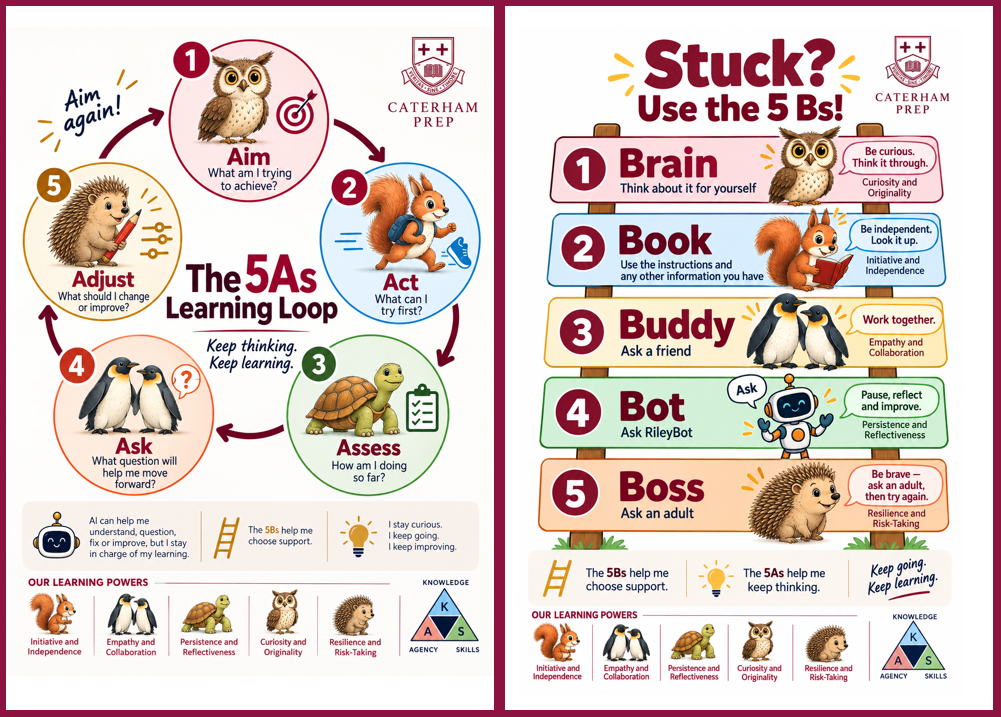
You may recognise our 5Bs: Brain, Book, Buddy, Bot and Boss, which came out of our first research programme. This approach helps children consider different sources of support, with AI taking its place alongside their own thinking, books, classmates and teachers. Coming out of our second study, our teaching also considers Knowledge, Skills and Agency (choice and creativity), including opportunities for children to make informed choices about their learning.
The forthcoming coalition report, which includes Caterham Prep’s findings, is pending publication and will be presented to the Department for Education and other education stakeholders later this year. It brings classroom evidence into the wider discussion about responsible and effective AI use in schools.
This work is closely connected with research and professional learning at the Senior School, across the Caterham Family of Schools, the national HMC school network and the 600+ IAPS schools that we advise on through our national leads on Innovation and Art.
For our children, the purpose is practical: asking ourselves every day “How could we do it better?” Better teaching, thoughtful use of technology and more opportunities to develop the judgement and independence they need to take ownership of their learning.
Back to all news